A production-style governed AI platform running agents in two operational environments (HR workflows and Support Operations) on one gateway. Same guardrails, same audit trail: the LLM proposes, the gateway decides.
- Risk tiers: Auto · Approval · Block
- 3
- Eval assertions · CI
- 59
- Deployed API + web
- Live
Controlled autonomy
Risk-tiered tool authorization (auto / approval / hard-blocked), enforced in the gateway, not the prompt
Approval workflow re-runs the full policy check before anything executes
ACL-aware RAG filtered by tenant and role at the query level, plus cross-tenant isolation
End-to-end audit: every turn, tool decision, approval, and remediation traced
Delivery & verification
Deterministic eval suite (16 scenarios) incl. adversarial; runs in CI on every push
Provider failover: ox-alpha → Cohere → offline mock
FastAPI on Render, Next.js on Vercel, deployed from main via the render.yaml blueprint
Multi-tenant isolation: Supabase RLS on every tenant-scoped table
Evidence-grounded campaign review with human authorization. Analyzes evidence, cites sources, detects contradictions and missing evidence, and prepares recommendations. Humans make the final decisions.
- Eval fixtures · deterministic
- 30
- Contradiction detection
- 1.00
- Missing evidence recall
- 1.00
- Citation correctness
- 0.875
Judgment stays human
Abstains on uncertainty instead of guessing
Injected instructions in untrusted evidence stay contained
Sensitive and cross-border cases escalate to specialists
Evidence
Deterministic fixtures with versioned results
Full audit trail on every review action
Tenant-isolated data access enforced by row-level security
A B2B SaaS prototype that reads simulated usage, billing, and support signals, then scores churn risk per account, shows the evidence behind each score, and recommends the next action.
Status: Prototype · Synthetic data
- Data end to end
- Synthetic
- Evidence per score
- Cited
- Eval + regression suite
- In progress
How the engine decides
Combines usage decay, billing events, and support signals into one per-account risk view
Attaches the evidence behind every score, so a reviewer can check it
Shows which signals pulled the score up or down instead of returning a bare label
Recommends a next action and states why it picked that one
Evaluation approach
Classification measured against known-risk scenarios, not plausibility
Explanations scored on evidence grounding and contradiction handling
Regression fixtures pin engine behaviour across changes
Consistency checks keep the demo equal to what the engine computed
A local-first waste scanner for AI agent CLIs like Hermes, Claude Code, and OpenCode. Surfaces exactly what is wasting RAM, disk space, and tokens on your machine, with zero data leaving the device.
- Layers — scan · cost · heuristics · intercept · sandbox
- 5
- Network calls / telemetry
- 0
- Local-first
- macOS
What it detects
Tool bloat — expensive tools enabled by default that inflate context and slow inference
Dead profiles and orphan cron jobs consuming disk and keeping remote models warm
Memory-layer pressure and heuristic warnings: cache bloat, prompt growth, auto-routing
Real token accounting read from ~/.hermes/state.db (SQLite)
Design
100% local detection — no network calls, no telemetry
Opt-in interception shim: fail-open by default, opt-in fail-closed mode with audit-logged bypass
Experimental Layer 5 sandbox-exec wrapper with a deny-default SBPL profile
Single-developer, macOS-first, network-off by default
Terminal-Bench style C++ benchmark for testing whether coding agents can solve a hidden 2D heat-equation task under private cases and shared runtime constraints.
- Reference error
- 0.00113
- Error gate
- 0.005
- Replay baselines
- 3
Evaluation Harness
Docker verifier with hidden manufactured solutions
Trusted ADI/Crank-Nicolson numerical reference
Replay baselines for Codex, adversarial Codex, and Claude artifacts
Reference-margin audit strengthened the trusted solver without changing the agent-facing task
Result
Rejects coarse time stepping, explicit instability, and brute-force over-resolution
Prior pass artifacts replay to reward 0.0 while the trusted reference remains deterministic
Fresh Claude run produced a failing partial artifact before hitting provider rate limits
A local-first execution layer for agent workflows: model routing, durable queues, and verifier-first gates that keep autonomy measurable and controllable.
- Default route
- Local
- Queue state
- Durable
- External effects
- Gated
Architecture
Routing: MLX local-first, policy-gated fallback providers
Orchestration: SQLite-backed queues with state, retry, recovery
Supervision: containerized service lifecycle management
Resource gating: pauses dispatch under memory pressure
Observability: execution traces + queue-state monitoring
Quality gates (in progress): tests/scans/approvals before any external effects
Positioning: control plane + gates
PythonMLXSQLiteDocker
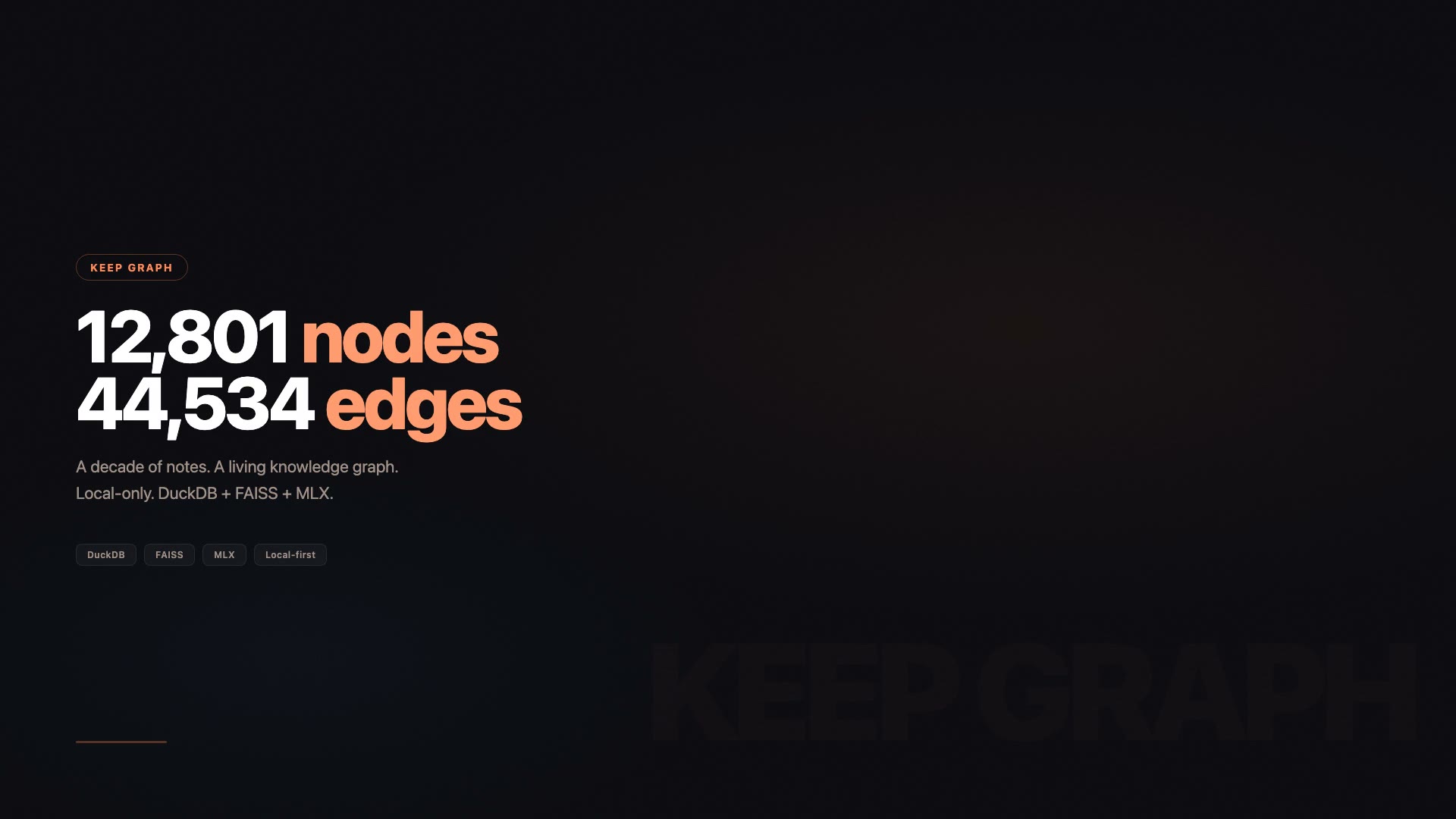
10 years of Google Keep notes turned into a knowledge graph — 1,032 wiki pages, 12,801 nodes, 44,534 edges. Mapped.
- Nodes
- 12,801
- Edges
- 44,534
- Wiki pages
- 1,032
Pipeline
Load all Google Keep Takeout notes (JSON)
Filter relevant notes with Qwen 0.6B classifier
Extract concepts per note with Qwen 27B
Deduplicate and canonicalize concepts with Qwen 27B
Synthesize wiki pages per cluster with Qwen 27B
Build graph.json and render D3 force layout
Infrastructure
Extracted entirely on-device using local LLMs (Qwen 0.6B + 27B via Apple MLX)
Multilingual: English, Albanian, Arabic with cross-language concept deduplication
Per-concept wiki synthesis across 1,032 generated pages
Interactive D3 timeline spanning 2015 to 2026
PythonMLXQwen 0.6B / 27BD3.jsLocal-First
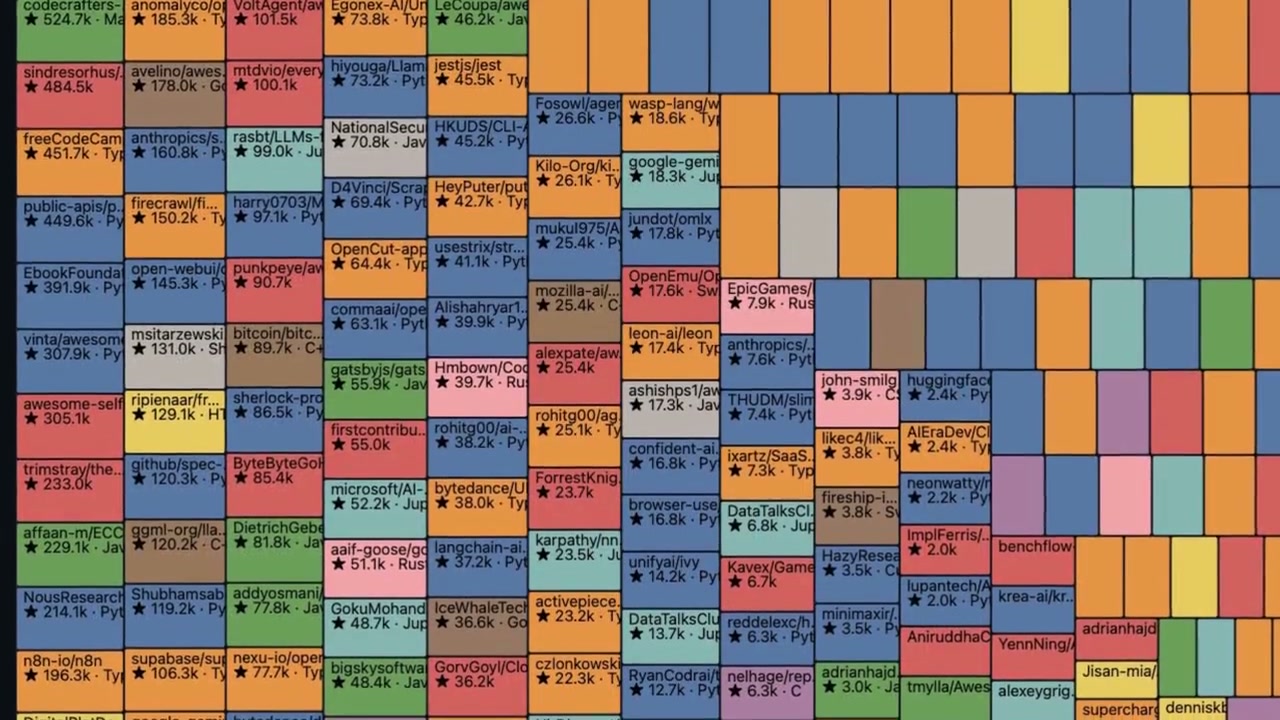
An interactive treemap that turns a GitHub user's public starred repositories into searchable, filterable tiles sized by popularity and colored by language.
- Sign-in
- GitHub App
- Repository data
- Public only
- License
- MIT
Experience
Search and filter starred repositories by language or topic
Open any repository directly from its treemap tile
Explore a bundled preview before signing in
Security and delivery
GitHub OAuth tokens remain on the server and never reach the browser
Signed, short-lived HttpOnly cookie protects the OAuth PKCE flow
Astro and D3 application deployed as a public beta on Render
High performance simulation engine built to evaluate vector synchronization, relational aggregation, and orchestration performance across multi-service architecture.
- Seasons
- 10
- Player vectors
- 4,940
- Local runtime
- ~16s
Pipeline Stages
Stage 1: Draft Generation
- 7 rounds × 32 picks
- Automated attribute scoring matrices
- Prospect generation and ranking logic
Stage 2: Embedding System
- 4,940 player vectors
- PyTorch VAE clustering into 12 archetypes
- Low-latency similarity retrieval via ChromaDB
Stage 3: Season Simulation
- 17-week simulation engine
- Play-by-play matchup execution
- Seeded variance and home-field weighting
Stage 4: Progression Engine
- Physical aging curves
- Development trait progression
- Rookie growth and veteran regression
Stage 5: Salary Cap & Front Office
- Rule-of-51 enforcement
- Dead-money calculations
- Asset valuation and trade logic
Supporting Systems
Coaching Layer
- Play-calling logic, scheme-fit metrics, and in-game adjustments.
Scouting Engine
- Regional grading pipelines and combine evaluation models.
Free Agency Marketplace
- Multi-agent contract bidding and team-fit valuation scoring.
Draft Intelligence
- Need-weighted board ranking and trade-up/down evaluation.
Infrastructure
DuckDB for structured OLAP analytics across ~1,700 entities
ChromaDB vector storage for 45-dimensional embeddings
Full 10-season franchise lifecycle simulation computed in ~16 seconds locally
PythonPyTorchDuckDBChromaDBMLXDockerNext.js
Local first transcription pipeline for Albanian (Kosovo dialect) with human-correction feedback loops and iterative fine-tuning workflows.
- Audio sources
- 901
- Quality metrics
- WER + CER
- Model sizes
- 5
Pipeline
901 curated YouTube audio sources processed through Faster-Whisper for segment-level transcription.
Configurable inference models from tiny to large-v3 with language auto-detection and re-ranking.
Human correction feedback loop for continual dataset refinement.
Observability
SQLite-backed tracking for inference latency, correction rates, WER, and CER.
Real-time monitoring dashboard across deployment variants and model sizes.
Structured evaluation workflows for reproducible ASR benchmarking.
WhisperFaster-WhisperPythonASRSQLiteAudio ProcessingWeb UI
E-commerce and operational administration platform built with Next.js, Supabase, and automated fulfillment workflows. Handles order processing and backend admin automation.
Client-facing web systems and backend integrations across React, TypeScript, and Node.js. Focused on production deployment workflows and API integration layers.
Multilingual business platform with deployment automation and localization systems for multi-region operations.